Beautiful Floral Bouquet Illustrations: A Practical Guide for Designers
In the realm of graphic design, the choice of visual assets often dictates the tone and success of a project. Beautiful Floral Bouquet Illustrations represent a specific category of digital assets that bridge the gap between realistic photography and abstract vector art. These resources are not merely decorative; they serve as foundational elements for branding, packaging, and editorial design. For professionals and hobbyists alike, understanding the utility, format, and comparative advantages of these illustrations is essential for making informed decisions about which assets to integrate into a workflow.
Defining the Asset: What Makes These Illustrations Distinct?
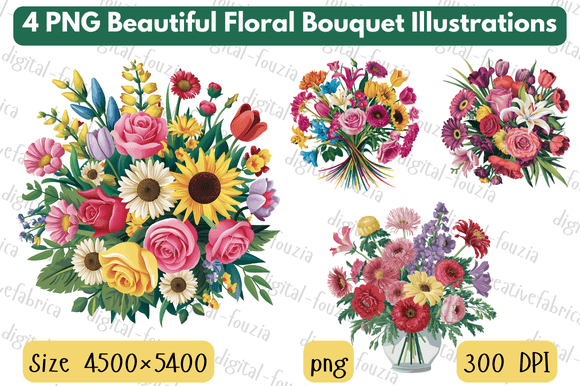
Beautiful Floral Bouquet Illustrations typically refer to high-resolution digital images featuring curated arrangements of flowers such as roses, sunflowers, daisies, tulips, and lilies. Unlike standard stock photography, which captures a moment in time with lighting constraints and background clutter, these illustrations are crafted to emphasize color vibrancy and compositional balance. The distinct value proposition lies in their technical specifications: they are provided in PNG format at 300 DPI with transparent backgrounds.
The 300 DPI resolution is a critical factor for print media. While many web-based graphics are optimized at 72 DPI, the higher pixel density ensures that when these bouquets are printed on physical materials like wedding invitations or product packaging, the edges remain crisp and the colors do not appear muddy. Furthermore, the inclusion of a transparent background eliminates the need for time-consuming post-processing. Designers can drag and drop these assets directly onto complex layouts without wrestling with magic wands or layer masks to remove white space.
Comparing Formats: Illustrations vs. Photography and Vectors
When evaluating visual resources, it is helpful to compare Beautiful Floral Bouquet Illustrations against other common formats: stock photography and scalable vector graphics (SVG/EPS). Each option serves a different purpose and comes with its own set of tradeoffs.
- Stock Photography: Photographs offer realism but often lack flexibility. A photo of a bouquet is tied to a specific lighting condition and background. If a designer needs to place a bouquet on a dark blue texture, a photo with a white background requires significant editing to look natural. Additionally, photos can sometimes feel generic or overused in certain niches.
- Vector Graphics: Vectors are infinitely scalable and editable, allowing designers to change the color of individual petals. However, creating a highly detailed, textured floral illustration in vector format is time-intensive and can result in heavy file sizes if not managed well. Vectors also sometimes lack the organic, painterly texture that raster illustrations provide.
- Raster Illustrations (PNG): The Beautiful Floral Bouquet Illustrations fall into this category. They offer a middle ground. They possess the rich texture and depth of a painting or photograph but come pre-edited with transparency. While they are not infinitely scalable like vectors, the 300 DPI resolution covers almost all standard print requirements up to large poster sizes without visible degradation.
For projects requiring rapid turnaround where the focus is on composition rather than deep customization of individual flower shapes, these raster illustrations often outperform vectors in terms of efficiency. Conversely, if a brand requires a logo that must scale from a business card to a billboard, a vector approach would be more appropriate.
Evaluating Use Cases: Where Do These Assets Fit Best?
The versatility of Beautiful Floral Bouquet Illustrations makes them suitable for a wide array of creative projects, yet they shine brightest in specific scenarios. Understanding the context of use helps determine if this collection is the right fit for your current needs.
Print Media and Stationery
One of the most effective applications is in print stationery. The high resolution ensures that wedding invitations, thank you cards, and event flyers maintain professional quality. Because the illustrations feature vibrant, diverse flowers, they can set a specific mood—romantic with roses, cheerful with sunflowers, or elegant with lilies. The transparent background allows these elements to sit seamlessly over textured paper designs or intricate typography, which is a common requirement in invitation design.
Digital Marketing and Social Media
In the digital sphere, these assets are equally valuable. Social media graphics often require eye-catching visuals that stop the scroll. A flat, low-quality image can detract from a message, whereas a high-fidelity floral illustration adds a touch of nature's beauty that feels premium. Whether designing Instagram stories, blog headers, or email newsletters, the ability to overlay these bouquets on various colored backgrounds without halos or artifacts streamlines the design process.
Packaging and Branding
For small businesses, particularly those in the wellness, cosmetics, or artisanal food sectors, floral imagery conveys organic and natural qualities. Using these illustrations on product labels or boxes can elevate perceived value. Unlike a photograph which might imply a specific season or location, an illustration feels timeless and can be adapted to fit a broader brand identity.
Strengths, Tradeoffs, and Decision Factors
Before committing to a specific set of assets, it is prudent to weigh the strengths against potential limitations. Beautiful Floral Bouquet Illustrations offer several clear advantages, but they are not a one-size-fits-all solution.
Key Strengths
The primary strength is efficiency. With four unique bouquets included in the collection, designers have immediate variety without the need to commission custom artwork. The "ready-to-use" nature of the transparent PNG files significantly reduces production time. Additionally, the diversity of flowers—from daisies to tulips—ensures that there is likely a style that matches the desired aesthetic, whether rustic, modern, or classic.
Potential Limitations
The main tradeoff is scalability beyond the provided resolution. While 300 DPI is excellent for standard print, if a project requires a massive outdoor banner or a wall mural, the raster format may eventually show pixelation compared to a vector file. Another limitation is editability; unlike vector files, you cannot easily separate the stems from the blooms or change the color of a single petel without advanced photo manipulation skills. If a project requires total control over every element of the bouquet, these illustrations may require supplementary work.
When to Choose Alternatives
While Beautiful Floral Bouquet Illustrations are powerful tools, there are situations where alternative resources may be superior. If a client demands a completely unique, custom-drawn asset that no one else has access to, purchasing a stock illustration—even a high-quality one—may not meet the exclusivity requirement. In such cases, hiring a freelance illustrator to create a bespoke piece is the better path.
Similarly, if the design requires the bouquet to be manipulated dynamically—for example, having the flowers grow across a timeline animation—a vector-based approach or a 3D model would be necessary. Raster illustrations are static; they cannot be animated or deconstructed easily. Finally, for ultra-large format printing where the viewing distance is very close, a custom high-resolution photograph or a vector illustration might provide the necessary fidelity that a standard 300 DPI raster file cannot sustain when scaled up excessively.
Maximizing Value in Your Workflow
To get the most out of Beautiful Floral Bouquet Illustrations, consider how they interact with other design elements. Their vibrant colors should complement, not clash with, the typography and background textures used in the project. Because the backgrounds are transparent, experiment with blending modes to see how the flowers integrate with underlying patterns. For instance, setting a bright sunflower bouquet to "multiply" over a light cream background can create a softer, watercolor-like effect.
Furthermore, utilizing the variety within the collection allows for thematic consistency across a campaign. One bouquet could anchor a main poster, while another, perhaps featuring similar color tones but different flower types, could be used for social media teasers. This creates a cohesive visual language without the monotony of repeating the exact same image.
In conclusion, Beautiful Floral Bouquet Illustrations offer a robust solution for designers seeking high-quality, versatile floral assets. By balancing the convenience of transparent, high-resolution PNGs with an awareness of their limitations regarding scalability and editability, users can effectively leverage these resources to enhance everything from wedding invitations to digital marketing campaigns. As with any design tool, the key lies in matching the asset's capabilities to the specific demands of the project.