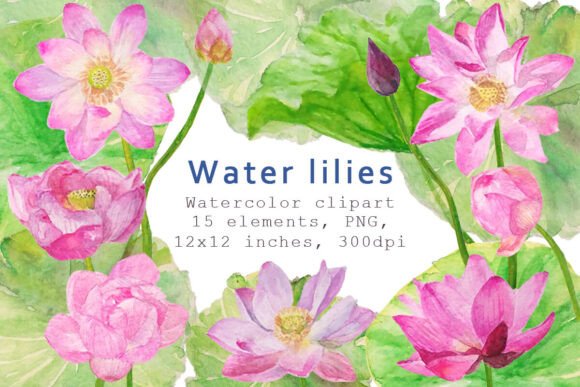
Watercolor Water Lily Clipart, PNG: A Practical Asset Evaluation
In the realm of digital design and creative planning, the choice of visual assets often dictates the final polish of a project. Watercolor Water Lily Clipart, PNG represents a specific niche within floral graphics that combines the organic unpredictability of traditional painting with the technical precision required for modern digital workflows. This collection is not merely a set of images; it is a toolkit designed for creators who need high-fidelity botanical elements to elevate their work without the overhead of commissioning custom illustrations. For professionals ranging from stationery designers to content creators, understanding the utility and limitations of such a resource is essential for maximizing its impact.
The Technical Foundation of High-Resolution Assets
The primary value proposition of this specific clip art pack lies in its technical specifications. The files are delivered as RGB PNGs with transparent backgrounds, a format standard for layering graphics over various textures and colors. However, the resolution sets this apart from generic stock imagery found on free repositories. With dimensions approximately 3600 x 3600 pixels, equating to roughly 12x12 inches at 300 DPI, these assets are engineered for print production rather than just screen display.
For a designer working on physical products, DPI (dots per inch) is a critical metric. Standard web images often hover around 72 DPI, which results in pixelation when printed. The 300 DPI standard ensures that when a water lily stem or bud is scaled up for a wedding invitation or a fabric print, the edges remain crisp and the color gradients stay smooth. This level of detail is particularly important for watercolor styles, where the soft bleeding of pigment must be preserved without digital artifacts. The inclusion of 15 separate elements allows for modular composition, enabling users to mix and match buds, stems, and full blooms to create unique arrangements rather than relying on pre-composed scenes.
Evaluating Artistic Style and Consistency
Hand-painted watercolor elements carry an inherent aesthetic weight that vector graphics struggle to replicate. The "hand-painted" aspect implies natural variation in stroke width, pigment density, and edge softness. In this set, the consistency across the 15 files is a key strength. Often, clip art collections suffer from mismatched lighting or style shifts between different elements, making them look disjointed when combined. Here, the cohesive palette and brushwork suggest a unified artistic vision, allowing for seamless integration into complex designs.
The subject matter—the water lily—is historically significant in design, symbolizing purity and renewal. Its broad leaves and delicate petals offer a versatile shape language. The inclusion of both buds and fully opened flowers provides narrative depth to a design. A planner page might feature a closed bud to represent a new beginning, while a wedding suite might utilize the open bloom for celebration. The ability to manipulate these elements individually gives the creator control over the focal point of their layout. Unlike rasterized photos, which can look heavy and literal, the watercolor treatment adds a layer of abstraction that pairs well with typography and other graphic elements.
Practical Applications Across Industries
The versatility of Watercolor Water Lily Clipart, PNG extends across several distinct professional sectors. Understanding these applications helps determine if this asset fits your current workflow.
- Stationery and Invitations: This is perhaps the most common use case. The high resolution supports large-format printing for wedding invitations, announcements, and greeting cards. The transparency of the PNG format allows the water lilies to sit atop textured paper backgrounds or intricate calligraphy without white boxes obscuring the text.
- Digital Scrapbooking and Planning: For the digital planner market, these assets serve as decorative headers, bullet points, or background accents. Because they are hand-painted, they add a warm, human touch to otherwise sterile digital interfaces, enhancing the user experience for planners and journalers.
- Fabric and Surface Printing: The 300 DPI resolution makes these files suitable for textile design. Patterns created using these elements can be printed on fabric for apparel, home decor, or quilting projects. The organic nature of watercolor translates exceptionally well to textiles, mimicking the look of block prints or tie-dye techniques.
- Web Design and Branding: While less common for corporate branding, these assets are excellent for lifestyle blogs, wellness websites, and boutique e-commerce stores. They can be used as photo overlays to soften harsh product photography or as section dividers to guide the reader's eye through content.
Workflow Integration and Usability
From a usability standpoint, the delivery of 15 separate files streamlines the design process. When assets are grouped together in a single image, extracting individual components requires time-consuming masking and erasing. By providing isolated PNGs, the creator saves hours of preparation time. These files integrate effortlessly into industry-standard software like Adobe Photoshop, Illustrator, Canva, and Procreate.
The RGB color mode is optimized for screens, but it is also generally acceptable for commercial printing, provided the printer has a calibrated color management system. However, for critical print jobs where exact color matching is paramount (such as brand identity), designers should be aware that RGB-to-CMYK conversion may slightly alter the vibrancy of the blues and greens typical in water lily illustrations. It is advisable to request a proof before committing to a large print run. Despite this minor consideration, the flexibility of having separate layers for stems, leaves, and flowers allows for non-destructive editing, meaning you can adjust opacity, blend modes, or position without degrading the original file quality.
Limitations and Considerations
While the quality is high, potential users should consider the stylistic constraints. Watercolor is a specific aesthetic that does not suit every brand voice. It conveys softness, nature, and elegance, but it may clash with ultra-modern, minimalist, or industrial design themes. Additionally, because these are raster images, scaling them beyond their native resolution will result in quality loss. While 3600 pixels is substantial, it is not infinite. If a project requires a mural-sized print, these files may not suffice without vectorization, which is difficult to achieve perfectly with watercolor textures.
Furthermore, the "hand-painted" nature means there is no perfect symmetry. For projects requiring geometric precision, these organic shapes may require additional manipulation to fit grid-based layouts. Users should view these assets as starting points for composition rather than rigid building blocks. The reliance on the PNG format also means that unlike SVG vectors, they cannot be resized infinitely without some loss of fidelity, though the high starting resolution mitigates this for most standard uses.
Long-Term Value for Creators
Investing in a high-quality set like Watercolor Water Lily Clipart, PNG offers long-term value by reducing the need for repetitive illustration work. Once acquired, these 15 elements can be reused across multiple projects, seasons, and client briefs. For small business owners and freelancers, this efficiency translates directly to profitability. Instead of spending days painting custom florals for each client, a designer can assemble a unique composition from this library in minutes.
The durability of the asset also lies in its timeless appeal. Floral trends cycle, but the classic water lily remains a staple in design, particularly for events and personal branding. The high resolution ensures that the files will not become obsolete due to advancements in printing technology, as 300 DPI remains the gold standard for print quality. By incorporating these elements into a portfolio or template library, creators build a reusable foundation that supports consistent output and professional presentation.
Ultimately, the decision to utilize this clip art pack depends on the alignment between the project's aesthetic goals and the technical requirements of the medium. For those seeking to infuse their digital or physical creations with the elegance of hand-painted botany, while maintaining the flexibility of digital assets, this collection offers a robust solution. It bridges the gap between artisanal craft and digital efficiency, empowering creators to produce polished, high-end results with confidence.